
Products
- Dry screw vacuum pump
Dry screw vacuum pump
- Vertical oil-free reciprocating vacuum pump
Vertical oil-free reciprocating vacuum pump
- Double-stage vertical oil-free reciprocating vacuum pump
Double-stage vertical oil-free reciprocating vacuum pump
- Rotary vane vacuum pump
Rotary vane vacuum pump
- 2BV Series Water Ring Vacuum Pump
2BV Series Water Ring Vacuum Pump
- 2BE Series Water Ring Vacuum Pump
2BE Series Water Ring Vacuum Pump
- Lobe-Rotary Vacuum Pump Unit
Lobe-Rotary Vacuum Pump Unit
- Reciprocating Roots vacuum pump unit
Reciprocating Roots vacuum pump unit
- Water ring Roots vacuum pump unit
Water ring Roots vacuum pump unit
- High vacuum diffusion pump unit
High vacuum diffusion pump unit
Water ring Roots vacuum pump unit
I. Product Overview
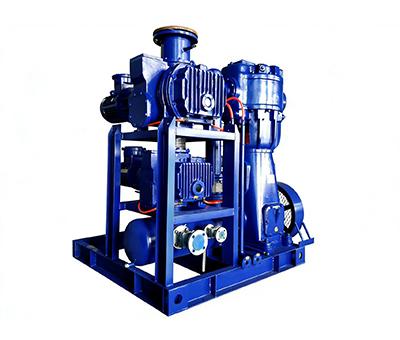
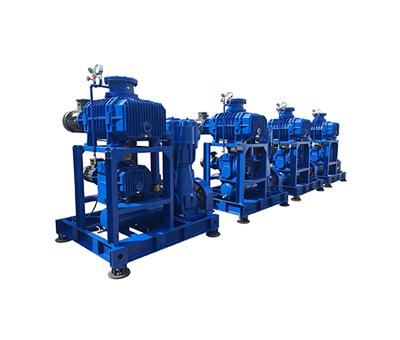
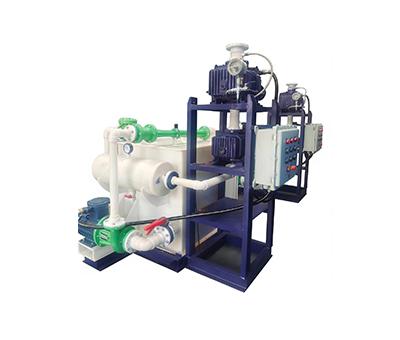
The water ring Roots vacuum unit adopts a combined structure of water ring vacuum pump and Roots vacuum pump connected in series. It belongs to a complete set of wet-type medium-high vacuum equipment. Among them, the water ring vacuum pump serves as the pre-pump at the front stage, responsible for the suction operation from atmospheric pressure to the medium-low vacuum range. The Roots vacuum pump acts as the booster pump, further enhancing the suction speed and vacuum level. The two work together in coordination to achieve efficient suction throughout the entire range.
The unit takes advantage of the water ring pump's characteristics of being resistant to water vapor and dust, having low cost and stable operation, and combines the advantages of the rotary vane pump in terms of large pumping speed and wide pressure range. The overall structure is compact, installation is convenient, and the operating cost is low. It can extract non-corrosive gases containing a large amount of water vapor and trace amounts of dust. No complex oil lubrication system is required, and there is no risk of oil mist pollution. It can operate continuously for 24 hours. It is widely applicable in various industrial conditions such as chemical, pharmaceutical, food, papermaking, metallurgy, environmental protection, vacuum drying, vacuum filtration, and material transportation, especially suitable for conventional industrial vacuum scenarios with water vapor and dust. It is a highly cost-effective universal vacuum unit.
Product Details
II. Core Basic Parameters
Air extraction rate: 108 – 8640 m³/h (30 – 2400 L/s). Test standard: Atmospheric pressure 101325 Pa, inlet water temperature 15℃, inlet air temperature 20℃. Measured performance deviation ≤ ±8%
2. Ultimate vacuum level: ≤ 200 Pa (for conventional 2BV + Roots compressor units), ≤ 500 Pa (for 2BE large heavy-duty + Roots compressor units), much higher than the vacuum level of a single water ring pump.
3. Working pressure range: 0.1 atm to 50 Pa, covering the entire range of low and medium vacuum levels, suitable for the continuous industrial vacuum extraction requirements.
4. Startup method: Linked intelligent start-stop control. The pre-stage water ring pump is prioritized for startup. Once the system pressure drops to the set threshold (≤1330Pa), the rotary compressor booster pump will automatically delay its startup to prevent overload and motor burnout.
5. Motor Configuration: The unit is equipped with dual motors. The water ring pump motor has a power range of 0.87–15kW (2BV series) and 7.5–900kW (2BE series), while the Roots pump motor has a power range of 0.75–11kW. All are Y series three-phase asynchronous motors with protection ratings of IP54/IP55. Customized explosion-proof and variable-frequency models are also available.
6. Operating temperature rise: Under rated operating conditions, the temperature rise of the water ring pump is ≤ 35℃, and the bearing temperature of the rotary vane pump is ≤ 75℃. The temperature rise is controllable and there is no risk of overheating.
7. Noise Index: ≤ 78 dB(A). The unit is equipped with a standard shock-absorbing base, significantly reducing operational vibration and noise. For heavy-duty models, a sound insulation component can be added.
8. Working environment temperature: -10℃ to 45℃, environmental humidity ≤ 90%RH (no condensation). For high-humidity conditions, an air-water separator can be used in conjunction.
9. Cooling method: The water ring pump is equipped with water cooling (through the circulation of working fluid for cooling), while the rotary vane pump is naturally air-cooled. For large power units, the rotary vane pump can be upgraded to forced air cooling for stable heat dissipation.
10. Protection device: Standard features include motor overload protection, pump body over-temperature protection, inlet and outlet pressure difference protection, vacuum check valve anti-backflow protection, and water shortage protection. The operational safety is very high.
III. Structure and Core Configuration Parameters
• Unit structure: Horizontal integrated frame design, water ring pump + Roots pump in a separate and compact layout. It occupies a small area, does not require complex concrete foundation, is easy to install and debug, and is highly mobile.
• Main body of water ring pump: Standard model features a HT200 gray cast iron pump body and an aluminum bronze impeller. For corrosion-resistant models, 304/316L stainless steel can be selected. There is no mechanical friction and the operation is smooth.
• Rotz pump body: QT500 ductile iron synchronous rotor, HT200 gray cast iron pump body, precise clearance design, no contact friction, no need for pump chamber lubrication, clean air extraction
• Sealing configuration: The water ring pump is equipped with a mechanical seal by default. The rotary vane pump uses a frame oil seal combined with a mechanical seal. The dual sealing system ensures no leakage and eliminates the risk of medium leakage.
• Lubrication method: Both pumps are lubricated with grease outside the bearings. There is no oil inside the pump chambers. Only the water ring pump uses clean water/special cooling liquid for operation, making maintenance very simple.
• Pipeline configuration: Standard equipment includes vacuum check valve, vacuum pressure gauge, differential pressure controller, steam-water separator, exhaust filter. Optional equipment includes vacuum gauge, solenoid valve, vacuum buffer tank.
• Control method: Standardly equipped with manual linkage control. Optional PLC fully automatic control system is also available, enabling automatic start/stop, fault alarm, water shortage reminder, and remote monitoring functions.
IV. Interface Specification Parameters
Total suction inlet diameter of the unit: DN50, DN80, DN100, DN125, DN150, DN200, DN250. Customization can be done according to requirements for non-standard products.
Exhaust pipe diameter: DN40, DN50, DN80, DN100, DN150, DN20
Cooling water pipe interface for working fluid: Standard NPT threads of 3/4", 1", and 1 1/2" sizes
European standard: RF concave flange in accordance with national standards. Customizable KF quick-connect flanges, chemical industry standard flanges, and American standard ANSI flanges are available upon request. The installation direction can be flexibly adjusted to adapt to the on-site pipeline layout.
V. Detailed Parameter Table of Typical Models
Unit model | Vacuum extraction rate(m³/h) | Absolute vacuum(Pa) | Water ring pump model | Rotary vane pump model | Total generator power(kW) | Inhalation aperture | Equipment weight(kg) | Noise(dB(A)) |
JSHZ-150 | 540 | ≤300 | 2BV5110 | ZJ-150 | 6.2 | DN80 | 293 | ≤72 |
JSHZ-300 | 1080 | ≤250 | 2BV5121 | ZJ-300 | 11.5 | DN100 | 625 | ≤75 |
JSHZ-600 | 2160 | ≤200 | 2BV5161 | ZJ-600 | 20.5 | DN150 | 755 | ≤76 |
JSHZ-1200 | 4320 | ≤200 | 2BEA203-0 | ZJ-1200 | 48 | DN200 | 980 | ≤78 |
JSHZ-2400 | 8640 | ≤500 | 2BEA153-0 | ZJ-2400 | 29.5 | DN250 | 1260 | ≤78 |
VI. Applicable Conditions and Customized Services
1. Dischargeable medium: Clean air, steam, inert gas, non-corrosive organic vapors. Can withstand a large amount of water vapor and a small amount of non-viscous and non-hard dust-containing gas. It is strictly prohibited to discharge flammable, explosive, highly corrosive, viscous particle-containing and hard particle-containing media.
2. Intake medium temperature: Standard ≤ 60℃. Customizable high-temperature version ≤ 80℃. Suitable for exhaust gas from high-temperature processes and humid hot gases for gas extraction purposes.
3. Core application scenarios: Chemical vacuum distillation, vacuum drying, food vacuum dehydration, pharmaceutical filtration, paper pulp dehydration, metallurgical vacuum degassing, environmental wastewater vacuum filtration, industrial material transportation, building materials vacuum molding
4. Customization Options: Available options include Ex d IIB T4 explosion-proof type, all-stainless-steel anti-corrosion type, variable-frequency speed control type, closed-loop water-saving type; additional features include vacuum buffer tank, automatic water replenishment system, and remote monitoring system.
5. Ancillary Services: Offer on-site installation and commissioning of the equipment, operation and maintenance training for the operators, on-site after-sales maintenance services, overall design of the vacuum system, support for customized and specially sized modifications, and closed-loop water-saving renovation services.
VII. Operating Precautions
The crew strictly follows the startup and shutdown sequence of the water ring pre-stage pump being started first, followed by the start of the Roots booster pump. It is strictly prohibited to start the Roots pump alone or to do so prematurely, as this could lead to excessive pressure difference at the inlet and outlet, causing the motor to overheat and the rotor to get stuck.
Before starting, it is essential to check the liquid level of the working fluid in the water ring pump to ensure it meets the standard. At the same time, check that the cooling water pipeline is unobstructed. It is strictly prohibited for the water ring pump to run without water to avoid damage to the impeller and pump body due to dry friction.
Before operation, check the sealing performance of the pipeline connections of the unit, the flexibility of the vacuum check valve, and identify any air leakage points. Eliminate the occurrence of vacuum backflow and pipeline leakage, which may lead to a decrease in the pumping performance and failure to meet the vacuum standards.
During operation, real-time monitoring of the working fluid temperature, liquid level, motor current of the water ring pump, bearing temperature of the rotary pump, and vacuum degree of the unit is carried out. Continuous operation beyond the temperature, pressure, and load limits is strictly prohibited. The working fluid temperature is recommended to be controlled at ≤ 30℃.
Regularly clean the carbonator separator and impurities and dirt inside the pump body. Replace the working fluid of the water ring pump regularly. Replace the lubricating grease for the bearings of the dual pumps every 3,000 hours. Replace the aging seals in time to ensure the operational efficiency of the unit.
When shutting down, first turn off the Roots booster pump. Wait for 3 to 5 minutes until the system pressure returns to normal. Then, turn off the water ring primary pump, simultaneously close the cooling water and makeup water valves to prevent the medium from flowing back and contaminating the pump body.
After the winter shutdown, the water in the pump body, pipelines and steam-water separator of the water ring pump must be drained to prevent the pump body and pipelines from freezing and cracking. For long-term shutdowns, the rotor of the dual pumps should be rotated regularly to avoid the rotor from getting stuck.
Service hotline: 0533-8225516 1506431898
- Products
- Dry screw vacuum pump
- Vertical oil-free reciprocating vacuum pump
- Double-stage vertical oil-free reciprocating vacuum pump
- Rotary vane vacuum pump
- 2BV Series Water Ring Vacuum Pump
- 2BE Series Water Ring Vacuum Pump
- Lobe-Rotary Vacuum Pump Unit
- Reciprocating Roots vacuum pump unit
- Water ring Roots vacuum pump unit
- High vacuum diffusion pump unit
E-mailzbbeihua@163.com
Scan with a QR code reader

COPYRIGHT Zibo Beihua Vacuum Equipment Co., Ltd. 鲁ICP备2026017228号-1
